Returning to work after an illness or injury often comes with its own set of administrative hurdles. Employers, for legitimate reasons related to workplace safety and compliance, typically require official documentation from a healthcare provider confirming an employee’s fitness to resume their duties. This essential piece of paper, commonly known as a doctor’s note, serves as a formal clearance, assuring the company that you are medically ready to return and outlining any necessary accommodations. It’s a crucial step in ensuring a smooth and safe reintegration into your professional routine, protecting both you and your employer.
Navigating this requirement can sometimes feel like an added stressor during recovery. This is where a well-structured return to work doctors note template becomes incredibly helpful. Having a clear, pre-formatted document ensures that all necessary information is included, leaving no room for ambiguity or back-and-forth communication between your employer and your doctor. It streamlines the process, making it easier for your healthcare provider to fill out and for your employer to understand.
Whether you’ve been out for a short period with a common cold or a longer duration due to a more serious medical condition, the quality of your doctor’s note matters. A comprehensive and clear note facilitates a quick and confident return to your role, minimizing potential delays or misunderstandings. Understanding what makes an effective template and how to utilize one can save you time and worry, allowing you to focus purely on your recovery and getting back on track.
What to Include in Your Return to Work Doctor’s Note
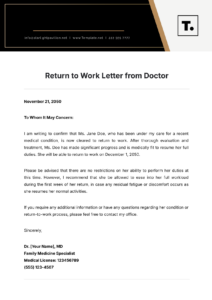
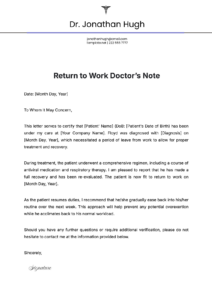
When preparing a return to work doctor’s note, clarity and comprehensiveness are paramount. The note needs to provide enough information for your employer to understand your situation without revealing overly sensitive medical details. It should confirm your ability to return to work and, crucially, specify any limitations or modifications that might be necessary for your duties. A well-crafted note minimizes questions and ensures a smooth transition back into the workplace.
First and foremost, the note must clearly identify you, the patient. This includes your full name and potentially your date of birth, though this isn’t always strictly necessary if other identifying information is strong. The date the note was issued is also vital, as is the period of absence it covers. This provides an immediate context for your employer regarding the duration of your leave and the official confirmation of your readiness to return.
Beyond your identification, the core of the note pertains to your medical clearance. It should state unequivocally that you have been seen by a medical professional and are deemed fit to return to work. For straightforward cases, a simple statement of clearance might suffice. However, if your absence was due to a more complex condition or injury, the note might briefly mention the nature of the condition, without going into excessive detail, and confirm your recovery progress.
Crucially, any restrictions or accommodations required for your return must be explicitly outlined. This is perhaps the most important part of the note for your employer, as it directly impacts your work responsibilities and environment. Examples could include a temporary reduction in hours, a modification of tasks, restrictions on lifting heavy objects, or the need for frequent breaks. These restrictions should ideally have an end date or a clear plan for reevaluation.
Finally, the note must bear the official mark of your healthcare provider. This includes the doctor’s full name, their professional title, their contact information (phone number, clinic address), and their signature. An official stamp from the clinic or hospital often adds to the note’s authenticity and professionalism. Without these identifying details, the note might not be accepted as valid documentation by your employer, leading to unnecessary complications.
Key Elements for a Seamless Return
To ensure your doctor’s note is effective and covers all bases, consider these essential components:
- Patient’s Full Name and any relevant identification.
- Doctor’s Full Name, Professional Title, and Contact Information.
- Date the Note was Issued.
- Dates of Absence from Work.
- Clear Statement of Medical Clearance to Return to Work.
- Any Specific Work Restrictions or Accommodations Needed.
- Duration of any Restrictions (e.g., “for the next two weeks”).
- Doctor’s Signature and Clinic Stamp (if applicable).
Ensuring that any restrictions are clearly articulated is fundamental. Ambiguous language can lead to misunderstandings that might impede your ability to perform your job safely or might even delay your return while clarification is sought. A good template prompts the doctor to be specific about what you can and cannot do, and for how long.
Why a Template Makes All the Difference
Utilizing a return to work doctors note template streamlines a process that can often be convoluted and time-consuming. For employees, it means peace of mind, knowing that when they visit their doctor, there’s a ready-made structure to ensure all necessary points are covered. This reduces the stress of wondering if they’ve forgotten to ask for specific information or if their employer will deem the note incomplete. It brings a level of consistency and professionalism to what might otherwise be a hastily scribbled note.
From the medical professional’s perspective, a template is an invaluable tool. Doctors and their administrative staff are often pressed for time, and having a standardized form ready to fill out saves precious minutes. They don’t have to draft a new letter from scratch each time, ensuring that key legal and practical requirements for an employee’s return are met without oversight. This efficiency benefits everyone involved, allowing doctors to focus more on patient care rather than administrative paperwork.
For employers, receiving a standardized, comprehensive note is equally advantageous. It provides clarity and reduces the need for follow-up questions or requests for additional information. Employers can quickly ascertain an employee’s return date, any restrictions, and the medical professional’s endorsement, which is crucial for workforce planning and ensuring compliance with occupational health and safety regulations. A consistent format also helps HR departments process these notes more efficiently.
- Ensures all necessary information is included, preventing omissions.
- Saves time for both medical professionals and patients.
- Reduces potential for miscommunication between all parties.
- Provides a professional and consistent standard for documentation.
- Helps employers understand the situation clearly and quickly.
A well-crafted doctor’s note is more than just a piece of paper; it’s a vital communication tool that facilitates a smooth transition back into the workplace after time away due to health reasons. By using a clear and comprehensive template, you ensure that all essential information is conveyed effectively, minimizing confusion and potential delays. This proactive approach supports your recovery journey and helps you reintegrate into your professional life with confidence and clarity, benefiting both you and your employer.
Ultimately, whether you are the employee, the healthcare provider, or the employer, having a reliable system for documenting a return to work makes the entire process more efficient and less stressful. It ensures that health considerations are properly addressed, workplace adjustments are clearly communicated, and everyone is on the same page for a successful and safe return to daily duties. This organized approach fosters trust and supports a healthy working environment for all.